































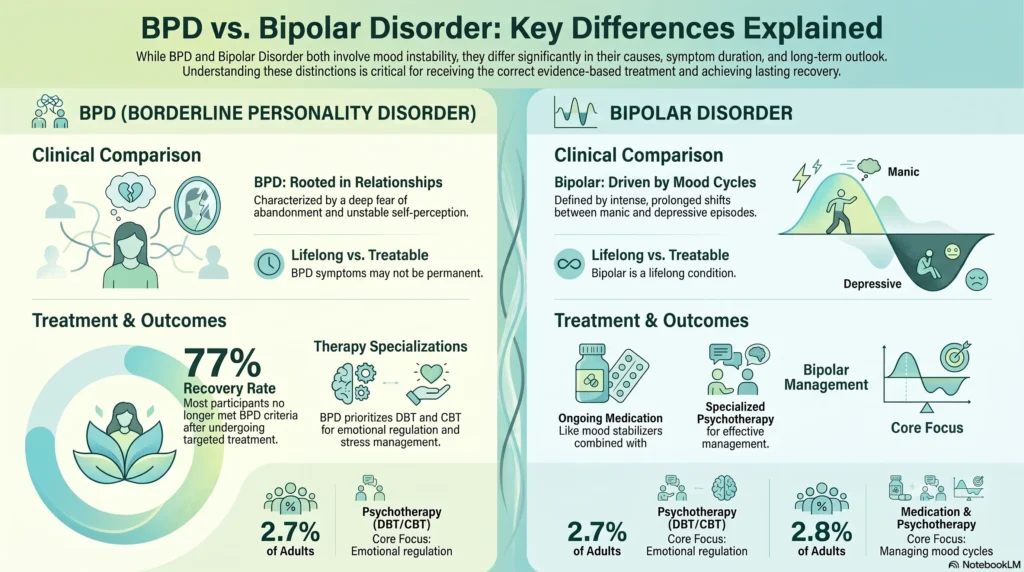
People commonly confuse Borderline Personality Disorder (BPD) and bipolar disorder because they sound similar, but they are two different mental health conditions. BPD is characterized by rapid mood swings, whereas bipolar disorder involves lifelong periods of depression and mania.
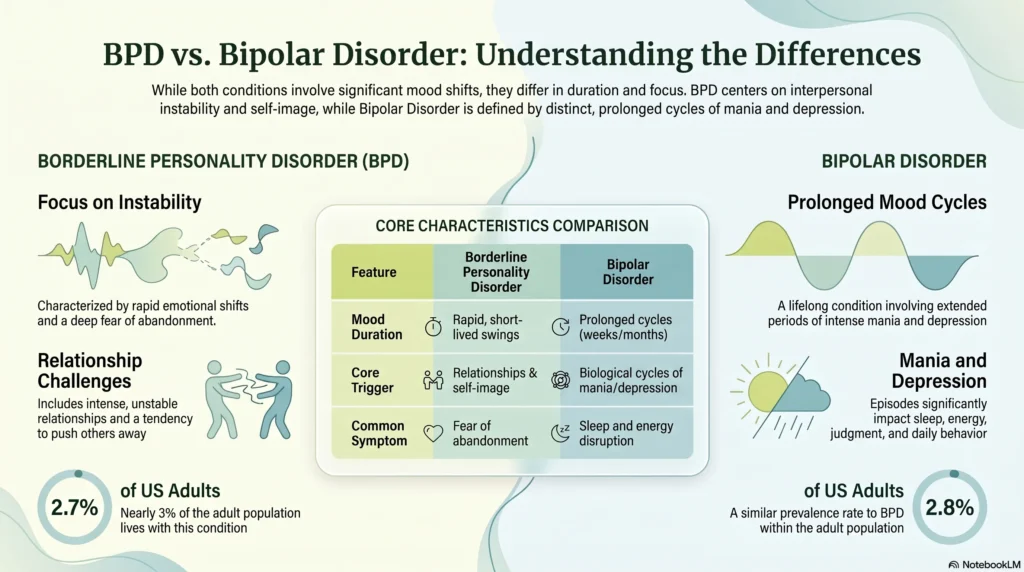
Up to 2.7% of the adult population in the US are living with BPD [1]. The percentage of people experiencing bipolar disorder is 2.8% [2].
Treatment exists for both BPD and bipolar disorder, and it’s effective. Understanding the differences between the two conditions is essential for seeking the right care and achieving greater stability. In this article, I explain BPD vs bipolar disorder, including the core differences, symptoms, and treatment.
What’s the Difference Between BPD and Bipolar Disorder?
Let’s first walk through what BPD is and what bipolar disorder is, highlighting the symptoms for each one.
Borderline Personality Disorder
BPD is a mental health condition where people struggle to feel good about themselves and other people. Being impulsive and having big emotional shifts are common symptoms for people with BPD, as is having a deep fear of being abandoned. Relationships are also particularly hard because people with BPD tend to push others away despite seeking closeness.
There’s no single cause of BPD, but research suggests that genetic, neurological, and environmental factors can influence the likelihood of a person developing it. Evidence does show that BPD runs in families, that problems with the serotonin transmitter in the brain are linked to BPD, and that trauma is common among people with BPD [3][4][5].
Symptoms of BPD include:
- Deep fear of abandonment
- Unstable, intense relationships
- Viewing yourself as bad or not existing
- Periods of paranoia or dissociation from reality
- Impulsive and risky behavior
- Threats of suicide or self-harm
- Rapid mood swings (often anger that is disproportionate to a situation)
Bipolar Disorder
Bipolar disorder is a lifelong mental health condition defined by extreme mood swings that can last for a prolonged period of time. It was previously called “manic depression.” People with bipolar experience bouts of mania and depression, which may occur at the same time (mixed episodes), and can happen regularly or rarely. Between these bouts, people often function normally.
During mania, people can feel euphoric and full of energy. During depression, people can feel hopeless and lose the ability to feel pleasure. Episodes of mania, depression, or mixed episodes affect sleep, energy, judgment, and behavior.
What causes bipolar is unknown, but genetics and brain structure and function are believed to contribute to the risks of developing the condition [2].
Symptoms of bipolar are categorized as manic, depressive, and mixed episodes. They include:
Manic episodes
- Feeling extremely happy
- Sudden mood changes
- Restlessness
- Rapid speech and racing thoughts
- Little need for sleep
- Impulsive or risky behavior
- Making unrealistic plans
Depressive episodes
- Deep sadness
- Fatigue
- Loss of motivation
- Feelings of hopelessness
- Inability to feel pleasure
- Trouble concentrating
- Suicidal thoughts
Mixed episodes include symptoms from both manic and depressive episodes, so a person may feel hopeless but also full of energy. People describe mixed episodes as very challenging.
BPD vs Bipolar Disorder: A Comparison Table
| BPD | Bipolar Disorder | |
|---|---|---|
| Summary | A mental health condition where people struggle to feel good about themselves and others. Characterized by a deep fear of abandonment. | A mental health condition where people experience intense, prolonged mood shifts known as manic, depressive, and mixed episodes. |
| Causes | Potentially genetics, problems with serotonin transmitters, and trauma. | Unknown but potentially genetics and brain structure and function. |
| Symptoms | Rapid mood swings, unstable relationships, very negative self-perception, dissociation, paranoia, impulsivity, threats of suicide. | Manic episodes include feeling extremely happy, sudden mood changes, reduced need for sleep, impulsivity, and racing speech and thoughts. Depressive episodes include hopelessness, suicidal thoughts, fatigue, and difficulties concentrating. Mixed episodes include symptoms from both manic and depressive episodes. |
| Lifelong condition? | Not necessarily | Yes |
| Affects | 2.7% of the US adult population | 2.8% of the US adult population |
| Treatment | Psychotherapy such as CBT and DBT, and medication if needed. | Psychotherapy, medication such as mood stabilizers, antipsychotics, and antidepressants |
Treatment for BPD vs Bipolar Disorder
Both BPD and bipolar disorder can be treated.
BPD is primarily treated with psychotherapy (talk therapy), including individual and group sessions. Some people may also require medication as part of treatment. Dialectical Behavioral Therapy (DBT) and Cognitive Behavioral Therapy (CBT) are the most common approaches for BPD.
DBT teaches people skills to emotionally regulate, manage stress and intense feelings, and learn how to build healthy relationships. CBT helps people with BPD recognize negative thoughts, reframe them, and lower anxiety. One study found that 77% of participants no longer met criteria for BPD diagnosis after undergoing treatment [6].
Treatment for bipolar disorder includes psychotherapy and medication, such as mood stabilizers, antipsychotics, and antidepressants. Because bipolar disorder is a lifelong condition, treatment must be ongoing and given by a healthcare professional (usually a psychiatrist) who specializes in bipolar disorder.
Therapy approaches for bipolar disorder include interpersonal and social rhythm therapy, CBT, and psychoeducation. Interpersonal and social rhythm therapy support stable daily routines such as eating, sleeping, and exercising. CBT can help identify triggers for manic, depressive, and mixed episodes. Psychoeducation teaches people with bipolar disorder, and the people around them, about the condition and how to manage it.
Treatment has been proven to help people with bipolar disorder develop skills to manage the lifelong psychosocial and interpersonal consequences of the condition [7]. Research also shows mood stabilizers can prevent the recurrence of depressive episodes and that antipsychotics are effective at treating mania [8] [9].
Expert, Effective Mental Health Treatment at Serenity Now, Davis, CA
We offer residential treatment for mental health disorders, including BPD and bipolar disorder. All our care is professional and empathetic and integrates evidence-based therapies, medication management, and wellness activities to help you feel whole as soon as possible. Our licensed clinicians personalize your treatment based on your current situation and future goals.
Our center in Davis is a calm environment where you can recover and reconnect with your healthiest self. We have 24/7 supervision to keep you safe and comfortable, and we help you develop the tools to be confident and to build high self-esteem.
You deserve serenity. Start your path here today. Contact our admissions team.
Sources
[1] Leichsenring, F. et al. (January 2024). Borderline personality disorder: a comprehensive review of diagnosis and clinical presentation, etiology, treatment, and current controversies. World Psychiatry.
[2] National Institute of Mental Health. Bipolar Disorder. nimh.nih.gov.
[3] Skoglund, C. et al. (June 2019). Familial risk and heritability of diagnosed borderline personality disorder: a register study of the Swedish population. Molecular Psychiatry.
[4] Martial, J. et al. (October 1997). Neuroendocrine Study of Serotonin Function in Female Borderline Personality Disorder Patients: A Pilot Study. Biological Psychiatry.
[5] Bozzatello, P. et al. (September 2023). The Role of Trauma in Early Onset Borderline Personality Disorder: A Biopsychosocial Perspective. Frontiers.
[6] Stiglmayr, C. et al. (December 2014). Effectiveness of dialectic behavioral therapy in routine outpatient care: the Berlin Borderline Study. Borderline Personality Disorder and Emotion Dysregulation.
[7] Novick, D. Swartz, H. (July 2019). Evidence-Based Psychotherapies for Bipolar Disorder. Focus.
[8] Geddes, J. Miklowitz, D. (December 2013). Treatment of bipolar disorder. The Lancet.
[9] Hyun Park, J. et al. (April 2024). Global perspectives on bipolar disorder treatment: in-depth comparative analysis of international guidelines for medication selection. BJPsych Open.