































Have you ever had the feeling that you’re carrying an emotional load that doesn’t belong to you? You may be experiencing generational trauma: when unresolved trauma is passed down from one generation to the next.
Across the world, 70% of adults say they have experienced at least one traumatic event in their lifetime [1]. Such experiences don’t just affect the people involved in them, they can be shared consciously or unconsciously with their children.
Unaddressed trauma manifests in many damaging ways, and it can be particularly confusing for the person who wasn’t even alive when the event took place. Fortunately, there is therapy for generational trauma, to help everyone heal and to break the cycle of transference.
What Is Generational Trauma?
Generational trauma is when the effects of a parent’s trauma are absorbed by their children. It’s sometimes called intergenerational trauma or transgenerational trauma.
Trauma is the physical and emotional response to a distressing event. These responses shape the person’s ability to function, form relationships, and process the trauma. Trauma can be a one-off event such as being in a car accident; ongoing, such as sexual abuse; or indirect, such as witnessing a death.
Generational trauma is not physical, but it can feel like a shapeless weight. Just as lessons and culture are passed down from generation to generation, so too is trauma that hasn’t been resolved.
How Is Generational Trauma Passed Down?
Generational trauma is not intentionally passed down. It happens over a long period of time, through a series of behavioral and biological pathways.
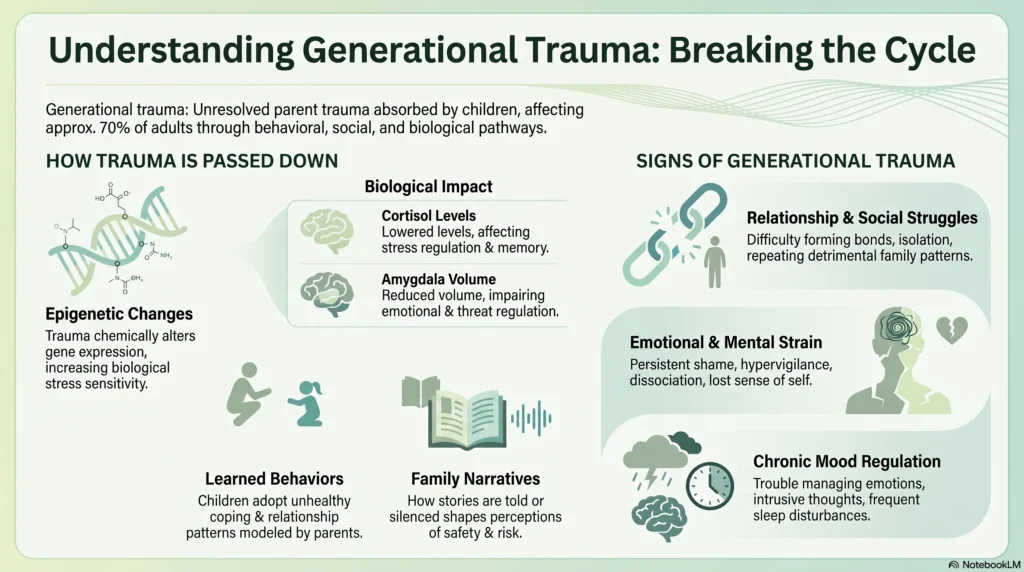
Learned behaviors. How parents learned to cope following their trauma is what they show to their children. Often, these methods are not healthy. They will also display relationship patterns, fears, and other residue effects from their trauma which, over years, inform and influence the next generation.
Family narratives. How parents tell the story of their trauma shapes how children understand risks and danger in the world. If the narrative is totally absent, the child may learn to value distance and have difficulty communicating.
Witnessing events. Children who see their parents’ trauma are directly impacted by it. For example, seeing domestic abuse or the death of a family member.
Epigenetics. Trauma can chemically alter how genes are expressed (without changing the genes themselves). This change can mean that children are biologically more sensitive to stress, or more likely to develop anxiety and posttraumatic stress disorder (PTSD) [2].
In particular, research has found that trauma exposure in parents can impact stress-related systems in their children, causing them to have lower cortisol levels. Cortisol helps regulate stress responses and memory formation around traumatic events [3].
One study also found that children of parents who were in an earthquake had small amygdala volumes. The amygdala is the brain region that processes emotions such as fear and threat detection. Its reduced volume can impair emotional regulation and an overactivate stress response in children [3].
What Are Signs Generational Trauma Is Present?
Generational trauma is complex and is not always obvious. Subtle signs that it may be present in your family include:
- Repeating detrimental behavioral patterns from your parents
- Dissociation, depersonalization, or derealization
- Difficulties forming and maintaining relationships
- Trouble expressing emotions
- Isolating yourself
- Feeling shame, guilt, or hopelessness
- Problems regulating mood
- Intrusive thoughts
- Hypervigilance
- Sleep disturbances
- Feeling unsafe
- Loss of sense of self
What Are the Repercussions of Generational Trauma?
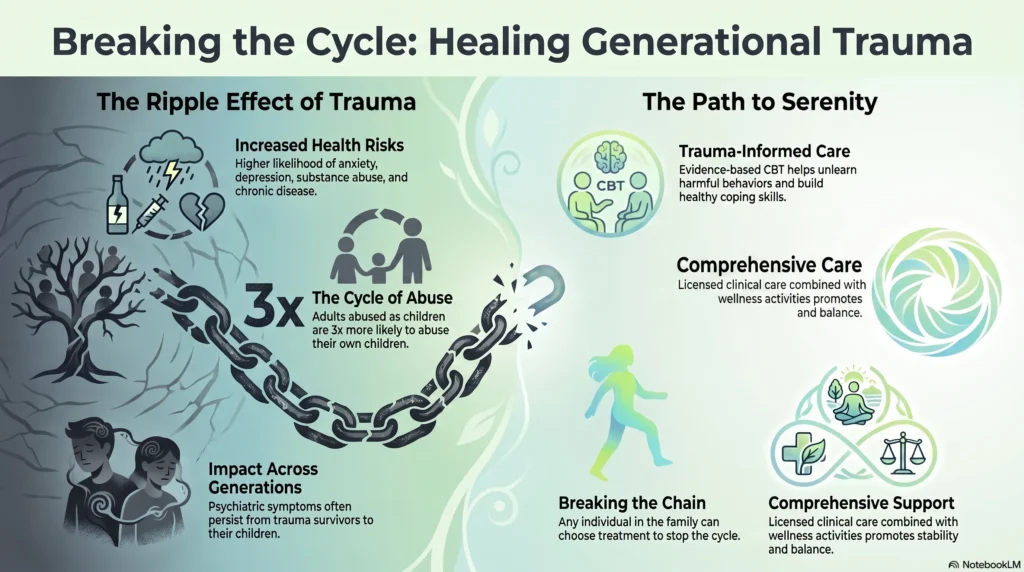
Generational trauma has many ripple effects. Not only can it take a similar toll on you as on your parents, it can pass down through generations until it’s fully processed.
Having generational trauma increases the likelihood of:
- Developing anxiety, depression, or other mental health disorders
- Abusing substances
- Having unstable or unhealthy relationships
- Experiencing financial hardship
- Developing a chronic disease
Generational trauma is a continuous cycle. Studies show that adults who were abused as children are three times as likely to abuse their own children [4]. Meanwhile, psychiatric symptoms among Holocaust survivors were also found to be present among their children [5].
How to Treat Generational Trauma
Generational trauma can be stopped. It starts with acknowledging the traumatic event and slowly taking steps to understand it. It’s not a quick process, and it can be very painful, but it’s deeply healing and can protect many people.
Trauma-informed care is widely available and is effective at treating generational trauma. In particular, evidence-based psychotherapy such as Cognitive Behavioral Therapy (CBT) can guide you to reflect on what happened, highlight thoughts around the event, build healthy coping skills, and unlearn behaviors that do not serve parents or children.
Healing from generational trauma can be something you do as a family unit, or as individuals. Ideally, the person who suffered the trauma undergoes treatment. However, anyone in the trauma chain can pursue treatment and ensure the cycle stops with them. It can feel like a burden, but the outcome is a gift to you, those around you, and those who will be around you.
Healing Starts Here at Serenity Now, Davis CA
We understand that generational trauma can have a lasting impact on your mental health, often connected to conditions such as anxiety, depression, and bipolar disorder. Our licensed team of clinicians help you reduce symptoms, find stability, and process trauma at a pace that feels comfortable for you.
We use CBT to address your story on a deeper level, and we tailor all care according to your needs. We also have a range of wellness activities, including access to the nearby country club, to complement clinical care and help you rediscover a sense of balance.
Our center in Davis provides 24/7 care to keep you safe.
Everyone deserves serenity. Start the path there today. Contact our admissions team.
Sources
[1] Benjet, C. et al. (May 2016). The epidemiology of traumatic event exposure worldwide: results from the World Mental Health Survey Consortium. Psychological Medicine.
[2] Chan, J. et al. (May 2018). Parental Advisory: Maternal and Paternal Stress Can Impact Offspring Neurodevelopment. Biological Psychiatry.
[3] El-Khalil, C. et al. (July 2025). Impact of intergenerational trauma on second-generation descendants: a systematic review. BMC Psychology.
[4] Greene, C. et al. (August 2021). Intergenerational effects of childhood maltreatment: A systematic review of the parenting practices of adult survivors of childhood abuse, neglect, and violence. Clinical Psychology Review.
[5] Dashorst, P. et al. (August 2019). Intergenerational consequences of the Holocaust on offspring mental health: a systematic review of associated factors and mechanisms. European Journal of Psychotraumatology.